

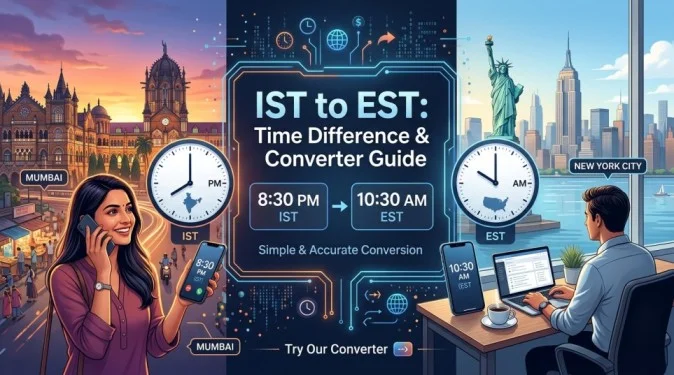
If you’re trying to figure out IST to EST, you’re probably looking for a quick way to convert Indian Standard Time to Eastern Standard Time. This can be useful when scheduling meetings, planning calls, watching live events, or communicating with someone in the Eastern Time Zone.
The main thing to remember is that IST is ahead of EST. Indian Standard Time (IST) is UTC+5:30, while Eastern Standard Time (EST) is UTC-5:00. This creates a 10-hour and 30-minute difference, with IST being ahead.
For example, when it is 10:00 AM IST, it is 11:30 PM EST on the previous day.
However, there is an important detail to understand: the Eastern Time Zone also observes Daylight Saving Time. During that period, it uses EDT instead of EST. This changes the time difference.
What Is IST?
IST stands for Indian Standard Time. It is the standard time used throughout India and is based on UTC+5:30.
Unlike some countries, India does not currently change its clocks for Daylight Saving Time. This means IST remains UTC+5:30 throughout the year.
For example:
- 8:00 AM IST
- 12:00 PM IST
- 6:00 PM IST
- 10:00 PM IST
All of these times remain on the same UTC+5:30 offset regardless of the season.
What Is EST?
EST stands for Eastern Standard Time. It is UTC-5:00 and is used during the standard-time portion of the year in parts of the United States and Canada.
Cities and regions that use Eastern Time include places such as New York, Washington, D.C., and Toronto.
When Daylight Saving Time is active, Eastern Time changes from EST to EDT (Eastern Daylight Time), which is UTC-4:00.
That’s why an IST to EST converter needs to know whether the Eastern location is currently observing standard time or daylight time.
IST to EST Time Difference
The difference between IST and EST is 10 hours and 30 minutes.
IST is ahead of EST.
For example:
| IST | EST |
| 6:00 AM | 7:30 PM previous day |
| 8:00 AM | 9:30 PM previous day |
| 10:00 AM | 11:30 PM previous day |
| 12:00 PM | 1:30 AM |
| 3:00 PM | 4:30 AM |
| 6:00 PM | 7:30 AM |
| 9:00 PM | 10:30 AM |
Notice that many morning IST times correspond to the previous day in EST. This is important when scheduling meetings or events.
How to Convert IST to EST
Converting IST to EST is straightforward when Eastern Standard Time is being observed.
Step 1: Start With IST
Take the Indian Standard Time you want to convert.
For example:
7:00 PM IST
Step 2: Subtract 10 Hours and 30 Minutes
Subtract the IST-to-EST difference:
7:00 PM − 10 hours 30 minutes = 8:30 AM
Therefore:
7:00 PM IST = 8:30 AM EST
If subtracting the time takes you past midnight, remember to move to the previous calendar day.
IST to EST Converter Examples
Here are some common IST to EST time conversions:
5:00 AM IST → 6:30 PM EST (previous day)
9:00 AM IST → 10:30 PM EST (previous day)
11:00 AM IST → 12:30 AM EST
1:00 PM IST → 2:30 AM EST
4:00 PM IST → 5:30 AM EST
7:00 PM IST → 8:30 AM EST
10:00 PM IST → 11:30 AM EST
These examples use EST specifically, meaning UTC-5:00.
IST to EST During Daylight Saving Time
This is where things can become confusing.
When the Eastern Time Zone observes Daylight Saving Time, it uses EDT, which is UTC-4:00 instead of EST.
During EDT, IST is 9 hours and 30 minutes ahead.
For example:
7:00 PM IST = 9:30 AM EDT
So, if you’re converting time for a location such as New York, don’t automatically subtract 10 hours and 30 minutes throughout the entire year.
Instead, check whether the location is currently using EST or EDT.
IST to EST for Meetings
Time-zone differences can cause confusion when scheduling international meetings.
Suppose someone in India wants to schedule a meeting at 8:00 PM IST during EST.
That would be:
9:30 AM EST
This can be a convenient meeting time for someone in the Eastern United States because it falls during their morning.
However, during EDT, the same 8:00 PM IST would be 10:30 AM EDT.
If you’re scheduling a business call, always include the date and time zone rather than simply saying “8 PM.”
Is IST Ahead of EST?
Yes. IST is significantly ahead of EST.
During standard time, IST is 10 hours and 30 minutes ahead of EST.
During Eastern Daylight Time, IST is 9 hours and 30 minutes ahead of EDT.
This means that when it’s daytime in India, it may still be the previous evening in the Eastern United States.
Why Is the Difference 10 Hours and 30 Minutes?
The difference comes from the UTC offsets.
IST is UTC+5:30, while EST is UTC-5:00.
To calculate the difference:
5 hours 30 minutes + 5 hours = 10 hours 30 minutes
That’s why IST is 10 hours and 30 minutes ahead of EST.
The half-hour difference can make manual conversions slightly less intuitive than conversions between whole-hour time zones.
Final Thoughts
Understanding IST to EST becomes much easier once you remember the basic difference.
When Eastern Standard Time is in effect, IST is 10 hours and 30 minutes ahead of EST. To convert IST to EST, subtract 10 hours and 30 minutes.
However, remember that the Eastern Time Zone observes Daylight Saving Time. During that period, it uses EDT, and the difference from IST becomes 9 hours and 30 minutes.
If you’re planning a meeting, call, event, or online activity, always check the date and whether the Eastern location is observing standard or daylight time. That small step can prevent missed appointments and confusing calendar errors.
Read Also : Is EarthLink Internet Good? Speed, Reliability & Gaming Guide
Frequently Asked Questions
What is the IST to EST time difference?
IST is 10 hours and 30 minutes ahead of EST when Eastern Standard Time is being observed.
What is 10 AM IST in EST?
10:00 AM IST is 11:30 PM EST on the previous day.
What is 8 PM IST in EST?
8:00 PM IST is 9:30 AM EST.
Is IST always 10 hours and 30 minutes ahead of Eastern Time?
No. During Daylight Saving Time, Eastern Time uses EDT, making IST 9 hours and 30 minutes ahead.
What does IST stand for?
IST stands for Indian Standard Time, which is UTC+5:30.