

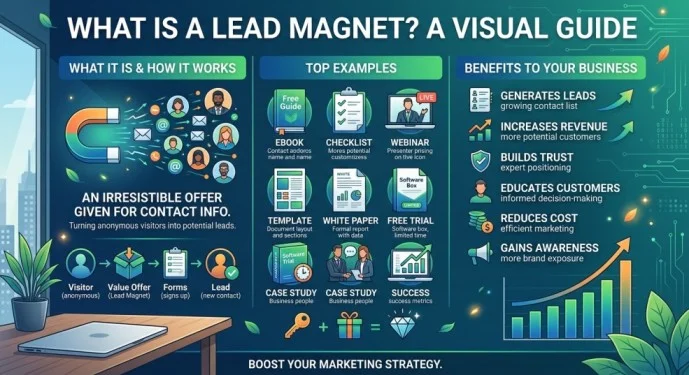
If you’ve searched “what is a lead magnet,” “is lead magnetic or not,” or even “Mailchimp what is a lead magnet,” you may be confused about what the term actually means. A lead magnet has nothing to do with the metal called lead. In digital marketing, a lead magnet is simply something valuable that a business gives away in exchange for a person’s contact information.
Lead magnets are commonly used by websites, online businesses, marketers, and email platforms such as Mailchimp to attract potential customers and build an email list.
What Is a Lead Magnet?
A lead magnet is a free resource, offer, or piece of content that encourages someone to provide their contact details, usually an email address.
The basic idea is simple:
Give something useful → Get contact information → Build a relationship with the potential customer.
For example, imagine you run a fitness website. You could create a free “7-Day Beginner Workout Plan” and ask visitors to enter their email address before downloading it. The workout plan is the lead magnet, while the person who signs up becomes a potential lead.The goal isn’t necessarily to make an immediate sale. Instead, a lead magnet helps businesses start a relationship with people who have already shown interest in a particular topic.
Why Are Lead Magnets Important?
Getting visitors to a website is useful, but having visitors doesn’t guarantee that they will become customers.
Once someone joins an email list, a business can send useful information, product updates, special offers, newsletters, or other relevant content.
A good lead magnet can therefore help with:
- Growing an email list
- Generating potential customers
- Building trust
- Increasing website engagement
- Promoting products or services
- Understanding what an audience wants
What Makes a Good Lead Magnet?
Not every free resource makes a good lead magnet. The offer needs to be useful enough that people are willing to exchange their information for it.
A good lead magnet is usually:
Relevant
It should match what the visitor is already interested in. For example, a website about photography could offer a free photography checklist rather than a random marketing ebook.
Useful
The resource should solve a problem or answer a question. People are more likely to sign up when they believe they’ll receive something genuinely helpful.
Easy to Use
A lead magnet shouldn’t be unnecessarily complicated. A short checklist, template, guide, or useful tool can sometimes work better than a 100-page ebook.
Easy to Access
After signing up, users should be able to receive the resource quickly. A complicated process can discourage people from using it.
Common Lead Magnet Examples
There are many different types of lead magnets businesses can create.
Ebooks and Guides
An ebook can provide detailed information about a specific topic. For example, a personal finance website could offer a free “Beginner’s Guide to Creating a Budget.”
Checklists
Checklists are popular because they’re simple and practical. A travel website could offer a “Vacation Packing Checklist,” while an SEO website could provide an “On-Page SEO Checklist.”
Templates
Templates save people time. Businesses can offer email templates, spreadsheet templates, social media templates, business plans, or design templates.
Discounts and Coupons
Online stores often use discounts as lead magnets. A visitor might receive 10% off their first order after entering an email address.
Free Courses
A short email course can also work well. Users may receive one lesson per day after joining an email list.
Webinars
Businesses can offer free webinars or online workshops in exchange for registration information.
What Is a Lead Magnet in Mailchimp?
If you’ve searched “Mailchimp what is a lead magnet,” the basic concept is the same.
For example, a company could advertise a free guide on its website. A visitor enters their email address through a signup form, and the business can then deliver the guide and add the person to its audience according to its setup and applicable consent requirements.Mailchimp itself isn’t the lead magnet. The free offer or resource is the lead magnet, while Mailchimp can be one of the tools used to collect and manage contacts.
How Does a Lead Magnet Work?
A typical lead magnet follows a straightforward process.After submitting the form, they receive access to the resource. The business can then continue communicating with the subscriber through relevant email content.The process can look like this:
Website visitor → Lead magnet → Signup form → Contact → Email relationship
Businesses should be transparent about what people are signing up for and follow applicable privacy and email marketing laws.
Lead Magnet vs. Regular Free Content
A blog post, video, or social media post can be completely free without being a lead magnet.
The main difference is the exchange.
If someone reads a free blog post without providing any information, it’s simply free content. If the business offers a downloadable guide in exchange for an email address, that guide functions as a lead magnet.
Final Thoughts
So, what is a lead magnet? It’s a valuable free resource or offer designed to attract potential customers and encourage them to provide contact information.The best lead magnet isn’t necessarily the biggest or most complicated one. It is the one that solves a specific problem for the right audience and provides genuine value.And if you were wondering about “is lead magnetic or not,” that’s a completely different question. In marketing, “lead” refers to a potential customer, not the chemical element lead.
Frequently Asked Questions
What is a lead magnet?
A lead magnet is a free resource or offer that a business provides in exchange for a person’s contact information, usually an email address.
What is an example of a lead magnet?
Common examples include free ebooks, checklists, templates, coupons, webinars, guides, and online courses.
What is a lead magnet in Mailchimp?
In Mailchimp marketing, a lead magnet is a free offer used to encourage people to join an email audience. Mailchimp can help businesses collect and manage those contacts.
Is a lead magnet always free?
Usually, yes. Lead magnets are normally free because the goal is to attract potential customers and encourage them to provide contact information.
Why do businesses use lead magnets?
Businesses use lead magnets to grow email lists, generate potential customers, build relationships, and provide value before asking people to purchase something.