

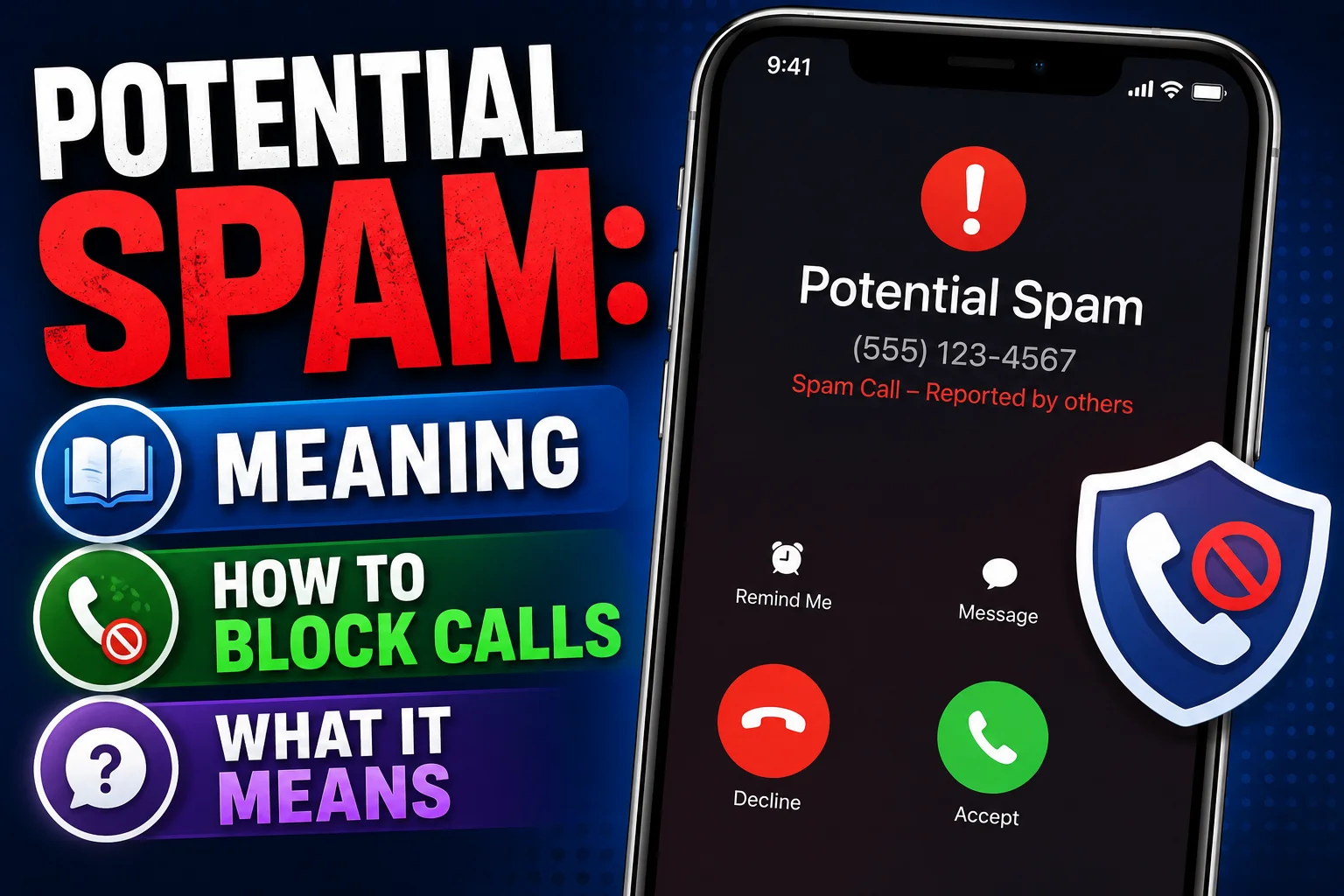
Seeing “Potential Spam” on your phone can be confusing, especially when an unknown number repeatedly calls you. This label generally indicates that your carrier or phone service has identified a call as potentially unwanted or suspicious.
In this guide, we’ll explain the potential spam meaning, what “Potential Spam” means in different languages, and how to block potential spam calls.
Read also; Pixel Blade Codes: Latest Roblox Codes for Free Rewards
What Does Potential Spam Mean?
Potential spam means a phone call has been identified as potentially unwanted, suspicious, or likely to be a spam call.
Your wireless carrier or phone’s spam-detection system may analyze information about incoming calls and label a number as “Potential Spam.” The label is a warning rather than proof that the caller is malicious.
A legitimate business or person can sometimes receive a spam warning if their number has been reported or flagged by a carrier’s detection system.
Potential Spam Meaning
The potential spam meaning is essentially “this call may be unwanted or suspicious.”
When your phone displays:
Potential Spam
it usually means the number has been flagged by a spam-detection system based on available calling data.
You don’t necessarily have to answer the call. If you don’t recognize the number, letting it go to voicemail can be a safer option.
Potential Spam Que Es
If you’re asking “potential spam qué es?”, it means “what is potential spam?”
In Spanish, “Potential Spam” can be understood as:
“Posible spam” or “posible llamada no deseada.”
The label indicates that an incoming call may be unwanted or suspicious.
Potential Spam En Español
Potential Spam en español can be translated as:
- Posible spam
- Posible llamada de spam
- Posible llamada no deseada
- Posible llamada sospechosa
The exact wording displayed on a phone depends on the carrier, device, operating system, and spam-protection service.
Why Does My Phone Say Potential Spam?
Your phone may display Potential Spam because your carrier or call-filtering service has identified the incoming number as potentially suspicious.
Common reasons include:
- The number has been reported by other users.
- The calling pattern resembles known spam activity.
- The number is associated with unwanted calls.
- A carrier’s spam-detection system has flagged the number.
- The number has characteristics associated with automated calling.
However, a spam label isn’t always accurate. A legitimate caller can occasionally be incorrectly identified.
How to Block Potential Spam Calls
If you regularly receive calls marked Potential Spam, you can use your phone’s built-in blocking features or your carrier’s spam-protection tools.
On iPhone
The exact menu names can vary by iOS version, but you can generally block an individual caller from the Phone app:
- Open the Phone app.
- Go to Recents.
- Find the unwanted number.
- Tap the information icon next to the number.
- Choose the option to block the caller.
You can also explore iPhone’s available call-filtering and unknown-caller features in Settings > Apps > Phone.
On Android
Android phones can have different menus depending on the manufacturer and version of Android.
Generally:
- Open the Phone app.
- Find the unwanted call in your recent calls.
- Select the number.
- Choose Block or Block/report spam if available.
Some Android devices also provide built-in spam protection that can warn you about suspected spam calls.
Should You Answer a Potential Spam Call?
If you don’t recognize the number, you generally don’t need to answer it.
If the caller claims to represent a bank, government agency, delivery company, or another organization and asks for sensitive information, don’t provide passwords, verification codes, payment information, or other confidential details.
Instead, independently find the organization’s official contact information and contact them directly.
What If a Legitimate Number Is Marked Potential Spam?
Spam-detection systems can sometimes make mistakes. If your own number or a legitimate business number is incorrectly labeled, the carrier or spam-filtering provider may have a process for reviewing or correcting the classification.
For an incoming call, you can also verify the caller through another trusted communication channel before sharing sensitive information.
Potential Spam vs. Spam
The labels are similar but don’t necessarily mean exactly the same thing.
| Label | General meaning |
| Potential Spam | The call may be suspicious or unwanted |
| Spam | The call has been identified as likely unwanted |
| Unknown Number | The caller’s identity isn’t recognized |
| Private Number | The caller has hidden their number |
The exact labels and detection methods vary between carriers and devices.
How to Reduce Potential Spam Calls
Besides blocking individual numbers, you can reduce unwanted calls by:
- Using your phone’s built-in spam protection.
- Enabling your carrier’s call-filtering service when available.
- Avoiding unnecessary calls back to suspicious numbers.
- Not sharing your phone number publicly when it isn’t necessary.
- Reporting unwanted calls through available carrier or device tools.
- Letting unfamiliar calls go to voicemail.
Remember that blocking one number may not stop spam completely because unwanted callers can use different numbers.
Conclusion
Potential Spam is a warning used by phones, carriers, and call-filtering services to identify calls that may be unwanted or suspicious. The potential spam meaning does not necessarily indicate that every flagged caller is a scammer, but it is a useful warning to exercise caution.
If you repeatedly receive these calls, use your phone’s blocking and spam-filtering features. When in doubt, don’t share sensitive information and verify important callers through trusted contact methods.
Frequently Asked Questions
What does potential spam mean?
Potential Spam means a carrier, phone, or call-filtering service has identified an incoming call as potentially unwanted or suspicious.
What is the potential spam meaning on a phone?
It is a warning that the incoming number may be associated with spam or unwanted calling activity. It does not necessarily prove that the caller is fraudulent.
Potential spam que es?
“Potential spam qué es?” means “What is potential spam?” In Spanish, it can be translated as “posible spam” or “posible llamada no deseada.”
How to block potential spam calls?
You can block individual numbers through your phone’s Phone app. You may also be able to enable spam filtering through your device or wireless carrier.
What does potential spam mean in Spanish?
Potential Spam en español can mean “posible spam,” “posible llamada de spam,” or “posible llamada no deseada.”
Can a legitimate call be marked Potential Spam?
Yes. Spam-detection systems can sometimes incorrectly flag legitimate numbers.
Should I call a Potential Spam number back?
If you don’t recognize the number, it’s usually better to avoid calling it back immediately. If the caller claims to represent an organization, contact that organization using independently verified contact information.