

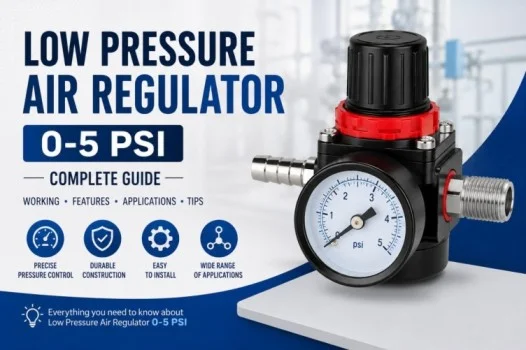
A low pressure air regulator 0-5 PSI is a precision device designed to reduce and control compressed air pressure within a very low operating range. Unlike standard air regulators that may handle pressures of 50, 100, or even several hundred PSI, a 0-5 PSI regulator is built for applications that require gentle, accurate, and consistent airflow.
These regulators are commonly used in pneumatic equipment, laboratory systems, gas and air control applications, HVAC equipment, instrumentation, and specialized machinery. Choosing the correct regulator is important because even a small pressure change can significantly affect equipment performance when working at such low pressures.
What Is a 0-5 PSI Air Regulator?
An air regulator controls the pressure of compressed air entering a system. A 0-5 PSI air regulator is specifically designed to provide an adjustable outlet pressure from approximately 0 to 5 PSI, depending on the model.
The regulator receives air from a higher-pressure source and reduces it to a controlled low-pressure output. An adjustment knob or screw allows the user to set the desired pressure. Many models also include a pressure gauge so the output can be monitored during operation.
Because the adjustment range is small, these regulators are generally designed for applications where precision is more important than high airflow.
How Does a Low Pressure Air Regulator Work?
The basic operation is similar to that of a conventional pneumatic regulator. Compressed air enters through the inlet port and passes through a valve. A diaphragm or piston responds to downstream pressure and adjusts the valve opening.
When the outlet pressure reaches the selected setting, the regulator restricts additional airflow to maintain the desired pressure. If downstream pressure drops because air is being consumed, the valve can open further to restore the set pressure.
In a 0-5 PSI regulator, the internal components are optimized for low-pressure control. This allows users to make smaller adjustments than they could with a regulator designed for a much higher pressure range.
Common Applications
Low-pressure air regulators can be found in many industries and systems. Common applications include:
- Pneumatic instrumentation
- Laboratory equipment
- Air-operated controls
- HVAC and burner systems
- Medical and scientific equipment
- Air sampling systems
- Small pneumatic devices
- Pressure testing equipment
- Industrial automation
- Specialized manufacturing machinery
They are particularly useful when excessive pressure could damage sensitive components or cause inaccurate operation.
Benefits of a Low Pressure Air Regulator
One of the biggest advantages of a low pressure air regulator 0-5 PSI is precise pressure control. A regulator with a narrow pressure range generally provides better adjustment for applications that require very low pressure.
Another benefit is equipment protection. Supplying a sensitive component with excessive pressure can cause leaks, inaccurate readings, premature wear, or mechanical damage. Reducing the pressure to an appropriate level helps protect the downstream system.
A low-pressure regulator can also improve consistency. Maintaining stable pressure can help pneumatic equipment operate more reliably and produce predictable results.
Choosing the Right 0-5 PSI Regulator
Before purchasing a regulator, check several specifications. The first is the pressure range. Make sure the regulator can provide the pressure required by your application. If your system needs 2 PSI, a 0-5 PSI model may be more suitable than a 0-30 PSI regulator because it offers finer adjustment.
Next, check the inlet pressure rating. The regulator must be capable of safely handling the pressure supplied by your air source.
Port size is another important consideration. Common connection sizes include 1/8-inch, 1/4-inch, and other threaded configurations. Confirm that the inlet and outlet connections match your existing equipment or use suitable adapters.
You should also consider airflow capacity. A regulator may provide excellent pressure control but still be unsuitable if it cannot deliver enough airflow for the application.
Regulator With or Without a Gauge?
Some low-pressure regulators include an integrated pressure gauge, while others do not. A gauge is useful because it allows you to monitor the outlet pressure directly.
For applications where accurate pressure adjustment is important, choosing a model with a gauge can make setup and troubleshooting easier. However, always verify that the gauge itself is designed for low-pressure measurement. A high-range gauge may make small pressure changes difficult to read accurately.
Installation and Adjustment Tips
Always follow the manufacturer’s installation instructions. Connect the regulator in the correct airflow direction and ensure that all fittings are properly sealed.
Before adjusting the regulator, confirm that the downstream equipment is suitable for the intended pressure. Start with a low setting and gradually increase it while monitoring the pressure gauge.
Avoid forcing the adjustment knob beyond its specified range. If the regulator does not maintain pressure, check for leaks, blocked filters, incorrect installation, or a regulator that is too small for the required airflow.
Read Also : Mara Jade’s Lightsaber: Color, History & Disney Canon
Final Thoughts
A low pressure air regulator 0-5 PSI is an excellent choice when an air system requires accurate control at very low pressure. Its narrow adjustment range makes it suitable for sensitive pneumatic equipment, instrumentation, laboratory systems, and other specialized applications.
When selecting one, consider the pressure range, inlet pressure, airflow capacity, connection size, materials, gauge accuracy, and compatibility with your air source. Choosing the right regulator can improve system reliability, protect sensitive components, and provide consistent low-pressure performance.
Frequently Asked Questions
- What is a low pressure air regulator 0-5 PSI?
A low pressure air regulator 0-5 PSI is a device that reduces and controls compressed air to an adjustable output pressure between 0 and 5 PSI. - What are 0-5 PSI air regulators used for?
They are commonly used in pneumatic equipment, laboratory systems, instrumentation, HVAC systems, air-operated controls, and other applications requiring precise low-pressure air. - Can a 0-5 PSI regulator handle high inlet pressure?
It depends on the specific model. Always check the manufacturer’s maximum inlet pressure rating before connecting the regulator to a high-pressure air source. - Should I choose a regulator with a pressure gauge?
A gauge can be helpful because it allows you to monitor the outlet pressure accurately. For low-pressure applications, choose a gauge designed specifically for the 0-5 PSI range. - How do I choose the right 0-5 PSI air regulator?
Consider the required pressure range, inlet pressure, airflow capacity, port size, connection type, materials, and whether you need an integrated low-pressure gauge.