

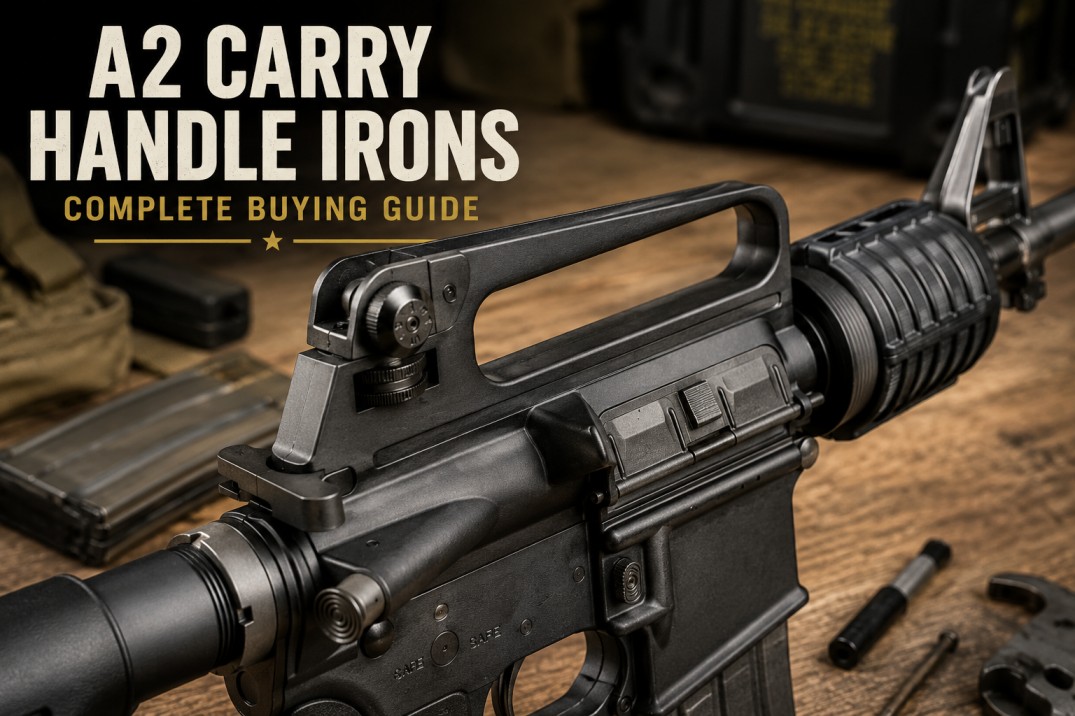
A2 carry handle irons are a classic feature of the M16 and AR-15 family. The design combines a raised carry handle with an integrated rear iron sight, giving the rifle its familiar traditional profile.
The A2 configuration is best known from the M16A2. It also influenced later military and civilian AR-pattern firearms. Today, the design remains popular with collectors, retro-style rifle enthusiasts, and people interested in traditional iron sights.
What Is an A2 Carry Handle?
An A2 carry handle is the raised section on top of an upper receiver that contains the rear iron sight.
Although it is called a carry handle, its primary purpose is not simply carrying the firearm. It houses the rear sight and forms part of the upper receiver.
The A2 design introduced an updated rear sight compared with earlier M16 configurations. It includes adjustments for windage and elevation, making it more versatile than the earlier sight arrangement.
What Are A2 Carry Handle Irons?
The term A2 carry handle irons refers to the iron-sight system built into an A2-style carry handle.
Unlike modern rifles that commonly use separate folding sights or optics, the traditional A2 setup has its rear sight integrated into the receiver.
The front sight works with the rear sight to create a traditional iron-sight system. This setup does not require a separate rear sight mounted on a rail.
What Is an A2 Carry Handle Upper?
An A2 carry handle upper is an upper receiver with the carry handle permanently integrated into its design.
This is different from a flat-top upper receiver. A flat-top design provides a rail where users can mount different sighting equipment.
The fixed A2 configuration is strongly associated with the M16A2 and is also used in civilian rifles designed to resemble classic military configurations.
A2 Fixed Carry Handle Upper vs. Detachable Carry Handle
The difference is mainly in how the carry handle is attached.
An A2 fixed carry handle upper has the carry handle built directly into the receiver. It is part of the receiver’s structure.
A detachable carry handle is different. It attaches to a flat-top receiver and can be removed when another sighting system is preferred.
The detachable design became more common as military firearms increasingly adopted optical sights and modular accessories.
A2 Carry Handle With Different Weapons
The A2 carry handle is most closely associated with the M16 family, although related configurations have appeared on other AR-pattern firearms.
M16A2
The M16A2 is the classic example of a fixed A2 carry handle configuration. Its receiver incorporated the distinctive carry handle and updated rear sight.
This rifle established much of what people now associate with the term “A2 upper.”
M16A3
The M16A3 retained the general A2-style receiver configuration while using a different fire-control arrangement. It is therefore another example of the A2 receiver design appearing on a closely related military rifle.
M16A4
The M16A4 marked a major change in receiver design. Instead of permanently integrating the carry handle, it used a flat-top receiver with a rail.
A detachable carry handle could be used with this configuration, but it could also be replaced by other sighting equipment.
M4 and M4A1
The M4 family also moved toward flat-top receivers. Early configurations could be equipped with detachable carry handles, while later configurations commonly used different sighting systems.
This distinction is important when comparing a fixed A2 upper with a flat-top receiver.
Civilian AR-15 Pattern Rifles
A2-style uppers remain available on civilian AR-pattern firearms. They are particularly popular for retro-style builds and firearms inspired by earlier M16 configurations.
However, “A2 style” does not guarantee universal compatibility between different manufacturers or receiver designs. Specific firearm specifications should always be checked before selecting components.
Why Is the A2 Carry Handle Still Popular?
The design has several qualities that continue to attract enthusiasts.
Classic appearance: The raised handle gives the rifle the recognizable look of earlier M16 models.
Integrated rear sight: The sight is built into the receiver rather than being a separate component.
Historical significance: The design is closely connected with the M16A2 era.
Simple configuration: The fixed receiver provides a traditional iron-sight arrangement without relying on an additional rear sight.
A2 Carry Handle vs. Flat-Top Receiver
The biggest difference is flexibility.
An A2 fixed carry handle upper has an integrated rear sight and carry handle. A flat-top receiver provides a rail that can accommodate different sighting options.
The flat-top design became increasingly popular as optics and other modular sighting systems became more common.
Neither design is automatically better. They represent different approaches that developed during different periods of firearm technology.
Also You may Like :Adflee: Complete Guide to Features, Instagram & Reddit
Final Thoughts
The A2 carry handle irons are an important part of M16 and AR-15 history. The design combines a raised carry handle, upper receiver, and rear iron sight into one distinctive configuration.
The A2 carry handle upper is most strongly associated with the M16A2, while the A2 fixed carry handle upper represents the classic integrated design.
Frequently Asked Questions
What are A2 carry handle irons?
They are the rear iron sights integrated into an A2-style carry handle and upper receiver.
What is an A2 carry handle upper?
It is an upper receiver with a permanently integrated carry handle and rear sight.
What is an A2 fixed carry handle upper?
It is an upper receiver where the carry handle forms part of the receiver instead of being a removable accessory.
Which weapon is most associated with the A2 carry handle?
The M16A2 is the firearm most strongly associated with the fixed A2 carry handle design.
Did the M16A4 use a fixed A2 carry handle?
No. The M16A4 uses a flat-top receiver with a rail and can accommodate a detachable carry handle.
Did the M4 use an A2 carry handle?
Early M4 configurations could use detachable carry handles, while later versions commonly used flat-top configurations with other sighting systems.