

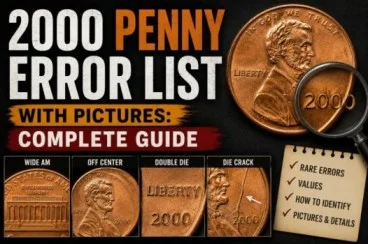
The 2000 penny error list with pictures is useful for collectors trying to determine whether an ordinary Lincoln cent could be worth more than face value. Most 2000 pennies are common, but certain varieties and genuine mint errors can attract collector interest.
The key is knowing the difference between a real mint error, a recognized variety, and ordinary damage. Scratches, stains, corrosion, dents, and wear do not automatically make a penny rare.
For 2000 Lincoln cents, collectors should pay particular attention to the Wide AM variety, 2000 Cheerios penny, and genuine mint errors such as off-center strikes and clipped planchets.
2000 Lincoln Penny Basics
The 2000 Lincoln cent was produced at several U.S. Mint facilities.
- Philadelphia: No mint mark
- Denver: D mint mark
- San Francisco: S mint mark, primarily for proof coins
A 2000 penny without a mint mark is normally a Philadelphia circulation coin. The missing mint mark itself is not an error.
The 2000 Lincoln cent was made from copper-plated zinc and normally weighs approximately 2.50 grams.
1. 2000 Wide AM Penny
The 2000 Wide AM is one of the most interesting varieties to check.
Turn the coin over and examine the letters A and M in the word AMERICA. On the Wide AM variety, the letters have noticeably greater separation than on the standard reverse.
PCGS recognizes the 2000 Wide AM as a collectible variety. Some 2000 circulation cents were struck with a reverse associated with proof production.
Use magnification and compare your coin with authenticated examples before deciding that you have a Wide AM.
2. 2000 Cheerios Penny
The 2000 Cheerios penny is another well-known variety.
Some 2000 Lincoln cents were distributed as part of a Cheerios promotional campaign. Certain examples have distinctive design characteristics and are recognized by collectors.
PCGS notes that multiple dies were involved in the Cheerios cents and that some examples have the Wide AM reverse. Original promotional packaging can also be helpful when establishing provenance.
If you believe you have a Cheerios penny, avoid cleaning it and preserve any original packaging.
3. Off-Center Strike
An off-center strike occurs when the planchet is incorrectly positioned when the dies strike the coin.
Possible signs include:
- Part of the design missing
- A blank area along one edge
- The design shifted toward one side
- An unusually wide edge
Large, clearly visible off-center errors are generally more interesting to collectors than minor examples.
4. Broadstrike Error
A broadstrike occurs when the coin is struck without proper containment from the collar.
This can make the penny appear wider than normal and may give it an unusual edge.
Compare the coin with an ordinary 2000 cent before calling it a broadstrike. Damage after the coin left the Mint can sometimes produce a similar appearance.
5. Clipped Planchet
A clipped planchet happens when the blank is improperly punched from the metal strip used to produce coins.
A genuine clip often creates a curved or crescent-shaped missing section along the edge.
A jagged, sharp, or irregular break may instead be damage that occurred after production, so authentication is useful for valuable-looking examples.
6. Die Crack and Die Break
A die crack develops when a coin die begins to fracture. The crack can appear as a raised line on the finished penny.
A larger fracture can develop into a die break, producing a more noticeable raised area.
Small die cracks are not necessarily rare. Dramatic die breaks may attract greater collector interest.
7. Die Chip
A die chip occurs when a small piece of the die breaks away.
The resulting coin can have a raised lump or bump on its surface. Collectors often inspect the date, lettering, and other design areas for these features.
Remember that a raised feature may be mint-made, while a scratch or indentation can be post-mint damage.
8. Strike-Through Error
A strike-through error occurs when foreign material comes between the die and planchet during striking.
Possible signs include:
- Missing design details
- Distorted lettering
- Unusual depressions
- Weak areas of the design
Not every depression is a strike-through. Damage and environmental effects can create similar marks.
9. Double Strike
A double-struck coin receives more than one strike from the dies. The second strike can produce overlapping or shifted design elements.
This is different from a doubled die. A doubled die is a die variety created during die production, while a double strike occurs during the actual striking process.
2000-D Penny Error List
A 2000-D penny was struck at the Denver Mint and has a D mint mark.
Collectors can examine these coins for:
- Off-center strikes
- Broadstrikes
- Clipped planchets
- Die cracks
- Die breaks
- Die chips
- Strike-throughs
- Double strikes
A D mint mark alone does not make a 2000-D penny rare or valuable.
2000 Penny With No Mint Mark
A 2000 penny with no mint mark is normally a Philadelphia-minted circulation cent.
Therefore:
2000 penny + no mint mark = normally Philadelphia
It should not automatically be described as a mint error.
PCGS records more than 5.5 billion 2000 Philadelphia cents, showing that the standard issue is extremely common.
How to Check a 2000 Penny
If you think you’ve found an error, follow these steps:
- Confirm the date is 2000.
- Check for a D mint mark or no mint mark.
- Examine the reverse, especially the AM in AMERICA.
- Use a 5x–10x magnifier.
- Compare the coin with a normal example.
- Inspect the edge for clips or unusual striking.
- Never clean the coin.
For an apparently significant error or variety, professional authentication can help determine whether the feature is genuine.
How Much Is a 2000 Error Penny Worth?
There is no single value for a 2000 error penny.
Potential value depends on:
- Type of error or variety
- Rarity
- Condition
- Visibility of the error
- Color and surface quality
- Collector demand
- Authentication
A normal circulated 2000 penny usually has little value above face value. A rare variety or dramatic authenticated mint error can be worth considerably more.
Be cautious with online listings claiming ordinary 2000 pennies are worth hundreds or thousands of dollars. An asking price is not the same as a confirmed sale price.
Quick 2000 Penny Error List
| Feature | What to Look For |
|---|---|
| Wide AM | Wider spacing between A and M in AMERICA |
| Cheerios penny | Promotional 2000 cent with documented characteristics |
| Off-center | Design shifted toward an edge |
| Broadstrike | Coin struck without proper collar containment |
| Clipped planchet | Curved section missing from edge |
| Die crack | Raised line from a cracked die |
| Die break | Larger raised area from a broken die |
| Die chip | Small raised feature |
| Strike-through | Missing or distorted design |
| Double strike | Evidence of two strikes |
Final Thoughts
Most 2000 Lincoln pennies are common, but some varieties and genuine mint errors deserve closer examination.
The Wide AM and Cheerios penny are particularly notable 2000 varieties, while genuine off-center strikes, clipped planchets, broadstrikes, die breaks, strike-throughs, and double strikes can also interest collectors. (PCGS)
Remember that a 2000 penny without a mint mark is normally a Philadelphia cent, not automatically an error. A 2000-D penny is also not valuable simply because it has a D mint mark.
If you find an unusual coin, do not clean it. Take clear photographs, compare it with reliable references, and consider professional authentication before assigning a high value.
Last updated: August 28, 2026
Read Also : 100,000 Pesos to Dollars: Current Exchange Rate Guide
Frequently Asked Questions
Is a 2000 penny with no mint mark rare?
No. A 2000 penny without a mint mark is normally a Philadelphia circulation cent.
What is the main 2000 penny variety to look for?
The Wide AM reverse is one of the key varieties collectors examine. Look closely at the spacing between the A and M in AMERICA.
What is a 2000 Cheerios penny?
It is a 2000 Lincoln cent distributed through a Cheerios promotional campaign. Certain examples have distinctive characteristics and are recognized by collectors.
Are all 2000-D pennies valuable?
No. Most are common. A genuine error, recognized variety, or exceptional condition can increase collector interest.
Is machine doubling the same as a doubled die?
No. A doubled die is a variety created during die production, while machine doubling occurs during the striking process.
How can I verify a 2000 penny error?
Compare your coin with reliable numismatic references and consider professional authentication if you believe it has a significant error or variety.